|
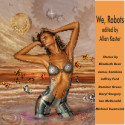
Edited by Allan Kaster
Stories by Elizabeth Bear, James Cambias, Jeffrey Ford, Dominic Green, Daryl Gregory, Ian McDonald, and Michael Swanwick.
Read by Amy Bruce and J. P. Linton
ISBN: 9781884612893
audible download price: $19.59

This is a collection of seven contemporary robot tales written by some of today's most acclaimed science fiction authors. A sentient war machine combs a beach for trinkets to create memorials for its fallen comrades in the Hugo Award winning story, "Tideline," by Elizabeth Bear. In "Balancing Accounts," by James Cambias, a small-time independent robotic space tug is hired by a mysterious client for a voyage between two of Saturn's moons. "The Seventh Expression of the Robot General," by Jeffrey Ford, involves a robot general coming to grips with his position in a world that no longer requires, or even understands, his role. A city awakens its ancient guardian as it is about to be invaded by a mining company in "Shining Armour" by Dominic Green. In "The Illustrated Biography of Lord Grimm," by Daryl Gregory, a country ruled by a super villain comes under attack by American super heroes . In "Sanjeev and Robotwallah," by Ian McDonald, a young boy becomes enamored with the armed robots that do the fighting in a Civil War and the celebrity boy-soldiers who pilot them. A robot acting as a scarecrow could be a desperate young boy's one chance of staying alive in "The Scarecrow's Boy" by Michael Swanwick. These are unabridged readings by Amy Bruce and J. P. Linton.
AUDIO REVIEW: We, Robots edited by Allan Kaster
REVIEW SUMMARY: Yet another fine audio collection from Allan Kaster.
MY RATING: 
BRIEF SYNOPSIS: A robot-themed audio short story anthology.
MY REVIEW:
PROS: Most of the stories were quite good; clear readings by the narrators.
CONS: The degrees to which robots are the central focus of the story varies.
BOTTOM LINE: A very good collection of stories overall.
Allan Kaster's latest sf audio short story anthology, We, Robots, collects stories involving robots. Of the seven stories it contains, only one was new to me; I read the others in various other anthologies and reading projects. That didn't stop me from enjoying them in audio form since (1) I recall these stories being very good, and (2) reading/listening experiences can differ. While I didn't find the previously consumed stories to fare any better or worse in audio form, I must say it was a treat to experience them all over again. That some of them are quite recent attests to their enjoyment value.
I've really enjoyed Kaster's previous audio collections (Mini-Masterpieces of Science Fiction, The Year's Top Ten Tales of Science Fiction, and Aliens Rule) and this one doe not disappoint either. The stories picked for this collection are quite good overall, but two of them stood out as outstanding: "The Seventh Expression of the Robot General" by Jeffrey Ford and "Tideline" by Elizabeth Bear.
Individual story reviews follow...
Michael Swanwick's "The Scarecrow's Boy" is the story of an obsolete house robot, now being utilized as a scarecrow, who is approached by a young boy who was the victim of a car accident. The scarecrow, against all his programming, takes it upon himself to finish the job of the boy's father, a diplomat looking to escape the country. The theme of free will is briefly explored here, though more ironic than thought-provoking as the scarecrow asks Sally (the robot car) about free will in the context of humans. Even so, this is a pleasant story overall. 
Daryl Gregory's "The Illustrated Biography of Lord Grimm" (originally reviewed in Eclipse Two edited by Jonathan Strahan) is an affecting (and political) story about the effects of war of civilians. In this case, American superheroes invade the land of Trovenia, ruled by Lord Grimm, and leave behind countless victims like Elena and her young brother. Elena is a steel worker in a factory that builds robots to fight the war. When the merciless American U-Men strike, casualties are high. Elena's struggle to escape the onslaught is quite engrossing. {C}{C}{C}{C}{C}{C}{C}{C}{C}{C}
It takes a long while to get interesting, but Dominic Green's "Shining Armour" eventually captures the reader's attention. It's the story of a small village taking a stand against the large city, with their only defense being the hulking military machine that has been sitting dormant in their village for some time. There's never any doubt who will assume the role of the Guardian's operator, but even so, it was a sweet feeling to see him flex his mechanical muscles and serve up just desserts. [This story was originally reviewed in The Solaris Book of New Science Fiction, Volume 2 edited by George Mann] {C}{C}{C}{C}{C}{C}{C}{C}{C}{C}
"The Seventh Expression of the Robot General" by Jeffrey Ford is more essay than story, conveying the story of a sentient, merciless military robot. He was both a hero (in the war with the Harvang) and monster (due to his mercilessness) and Ford's prose, which is delivered swiftly and with confidence, makes it one to remember. [This story was originally reviewed in Eclipse Two edited by Jonathan Strahan.] 
"Tideline" by Elizabeth Bear could be considered a small-scale post-apocalyptic story -- there's no definite description, as such, but the clues are there -- and that serves as a great background for a personal story of a dying sentient machine named Chalcedony and a young boy named Belvedere. Chalcedony is a military machine that has lost her entire platoon during battle and who builds necklaces in their honor (hopefully before she expires) out of shipwreck leftovers. Her attachment to Belvedere (which can only be described as one of motherhood) is both believable and touching. Despite being a machine, Chalcedony is such a well-drawn character that I couldn't help but feel sadness as her condition worsened - a reaction that can only be attributed to Bear's superb storytelling skills. Well done. [This story was originally reviewed as part of the 2008 Hugo Award Short Fiction Nominees reading project.]
In "Balancing Accounts" by James L. Cambias, robots and AIs have achieved a sort of autonomy, making their way through life like the rest of us. The narrator of this story, an artificial intelligence that runs a cargo ship, takes on unknown cargo from a mysterious stranger. A simple premise is made much more interesting by the fact that this particular AI takes it upon herself to avoid the direct instructions of the authorities who suddenly take a keen interest in the cargo (though we never quite find out why). [This story was originally reviewed in The Year's Best Science Fiction #26 edited by Gardner Dozois.]
During the tail end of war, a young boy named Sanjeev is befriended by a group of teen robot jockeys in "Sanjeev and Robotwallah". While the overall focus of this story is how the times change when the war ends, it is brought to life by the cool AI-controlled war robots. McDonald doesn't quite recapture the magic that he dealt out in River of Gods - the story needed seemed to lack its import - but it was nonetheless fun to return to that world. [This story was originally reviewed in Fast Forward 1 edited by Lou Anders.] {C}{C}{C}{C}{C}{C}{C}{C}{C}{C}
|